

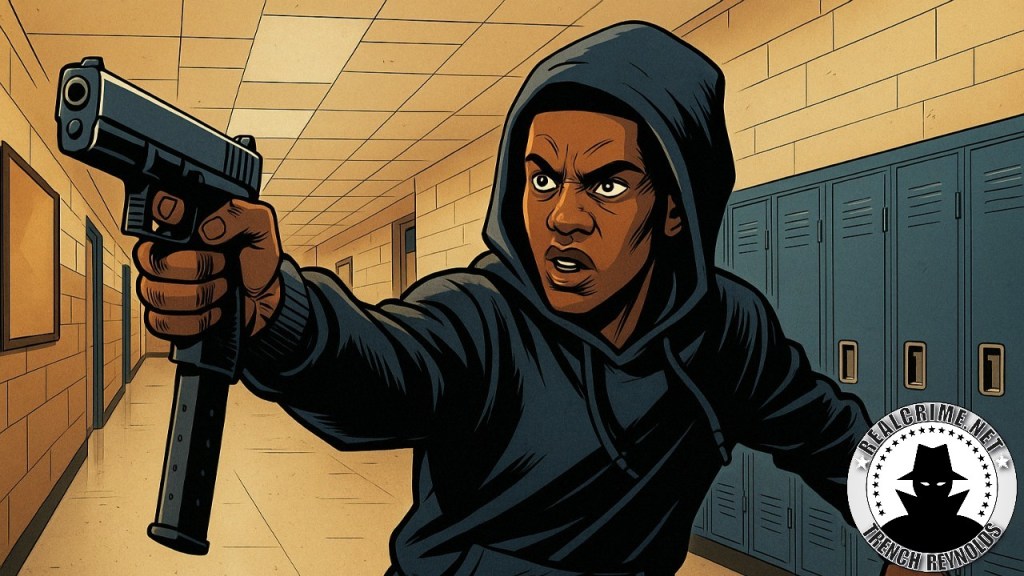
On Tuesday, April 15, 2025, a shooting occurred at Wilmer-Hutchins High School in Southeast Dallas. At approximately 1:03 p.m., surveillance footage captured an unidentified student opening an unsecured door to allow 17-year-old Tracy Haynes Jr. into the school building. Once inside, Haynes proceeded down a hallway where multiple male students were gathered. He then displayed a firearm and began firing at the students.
According to an arrest affidavit, Haynes fired indiscriminately and struck several individuals. He then approached one student who was unable to flee and appeared to take a point-blank shot. During the incident, the firearm reportedly jammed, possibly preventing further harm at that moment.
The shooting triggered an immediate response from students and staff, who followed lockdown procedures. Law enforcement arrived within minutes, including officers from the Dallas Independent School District Police Department, the Dallas Police Department, and additional agencies. The campus was placed on lockdown as emergency responders secured the scene. Students were evacuated to a nearby football stadium, where they were later reunited with family members.
Five individuals were taken to local hospitals following the shooting. Four students, aged between 15 and 18, were confirmed to have sustained gunshot wounds. A fifth individual, a 14-year-old girl, was transported separately about an hour later for anxiety-related symptoms. Two of the shooting victims were discharged the following day, while the other two remained under hospital care in stable condition.
One of the students who was shot is recovering physically, but emotionally, the impact is lasting. According to family members, he’s now afraid to return to Wilmer-Hutchins High School. He’s alive, but he doesn’t feel safe walking back into the building where he was nearly killed. That is the reality on the other side of every ‘school safety funding’ press release, but I digress.
After leaving the school, Haynes briefly remained unaccounted for. During this time, a man in DeSoto, Texas, unknowingly provided him with transportation. The man later stated that he was on his way to work near the high school when Haynes approached, claiming he had been in a car accident and needed a ride. Believing the request was genuine, the man drove Haynes to a nearby gas station and dropped him off, unaware of the events that had taken place earlier that day. He later recognized Haynes in news reports after learning about the shooting.
Later that evening, with assistance from the violence prevention group Urban Specialists, Haynes voluntarily turned himself in. He arrived at the Lew Sterrett Justice Center in Dallas at approximately 9:30 p.m. and was booked into the Dallas County Jail. He was charged with aggravated assault mass shooting, a first-degree felony under a 2023 Texas law that consolidates multiple aggravated assault charges from the same criminal incident into a single mass shooting charge.
This charge stems from House Bill 165, passed by the Texas Legislature in 2023. The law defines a mass shooting as an act that results in, or attempts to cause, serious bodily injury or death to four or more individuals during a single criminal episode. By combining what would otherwise be multiple aggravated assault charges into one, the statute allows for harsher penalties, including the possibility of sentences that must be served consecutively rather than concurrently. If convicted, Haynes faces between 5 and 99 years in prison. The case has not yet gone before a grand jury.
Haynes’ bond was set at $600,000. If released, he will be required to wear an ankle monitor. As of the most recent updates, no motive for the shooting has been officially disclosed, and the investigation remains ongoing.
While police have yet to announce a formal motive, there are signs this shooting may be tied to gang-related violence. And to be clear, this isn’t about the race of the suspect. It’s about the weapon. The image circulating from school surveillance shows Tracy Haynes Jr. wielding what appears to be a 9mm semiautomatic handgun fitted with an extended magazine.

That configuration isn’t common among ‘responsible gun owners™‘, or random school shooters. It’s a favored setup in gang circles, where high-capacity firepower is often a status symbol and a practical tool for escalation. In Texas, there is no legal limit on magazine capacity for handguns. You can carry a 33-round magazine just as easily as a 10-round one, and no one will stop you, not the law, not the background check, not the store clerk. If this does turn out to be gang-related, then we’re not just talking about school security anymore, we’re talking about unchecked firepower bleeding into school hallways.
Tuesday’s incident occurred just over a year after another shooting at the same high school. On April 12, 2024, a 17-year-old student brought a handgun onto campus and shot a fellow student in a classroom. That incident also bypassed existing safety protocols, including metal detectors and a clear backpack policy. Following the 2024 shooting, students staged a walkout to protest what they described as inadequate security enforcement. In response, the school district pledged to retrain staff on security procedures, increase personnel during arrival and dismissal, and improve enforcement of safety policies. Despite those promises, the school experienced another shooting almost exactly one year later.
In the hours after this most recent attack, Dallas ISD leadership was quick, almost suspiciously quick, to assure the public that this was not a failure of their staff, protocols, or machinery. That kind of preemptive denial, dropped into a live investigation, says more about liability panic than student safety. A student opened a door. A shooter walked in. Four teenagers were shot. But apparently, the district’s top concern was making sure no one mistook that for a systemic failure. If that’s not an institutional reflex at this point, it certainly looks like one.
Here’s the uncomfortable truth. Even if the metal detectors had been used properly, even if every backpack had been checked, even if every hallway had been staffed with trained personnel and reinforced policy binders, it still wouldn’t have stopped this. Because the shooter didn’t go through the front door. He came in through the side, invited in by another student, and opened fire. That’s the problem with building a system that only works when nobody breaks the rules. You’re not securing a school, you’re building a castle out of paper.
This is exactly why I come back, time and again, to the quote Mike Tyson made famous: “Everybody has a plan until they get punched in the face.” Dallas ISD had a plan. They had clear backpacks. They had metal detectors. And now they have four kids in the hospital. The punch landed hard, and the plan failed, again.
Governor Greg Abbott, meanwhile, did what he always does. He released a tidy little statement stuffed with platitudes and padded with dollar signs. He wrote, “Our hearts go out to the victims of this senseless act of violence at Wilmer-Hutchins High School.” He noted that he had “offered to support the school district families, students, and staff and to provide law enforcement with the tools they need to arrest the criminals involved and bring them to justice.” Then he trotted out the same figure he has for years, saying Texas has provided “over $3 billion in school safety funding,” and used this shooting as yet another launchpad to promote his request for “an additional $500 million to further safeguard schools across the state.”
What Abbott didn’t mention, again, is that none of this funding seems to be stopping the bullets. And he certainly didn’t bring up what he said back in 2022 after the massacre in Uvalde, when 19 children and two teachers were killed: “We want to end school shootings, but we cannot do that by making false promises.” That was his excuse for opposing even a modest increase in the minimum purchase age for assault rifles.
Instead, he pivoted, as he always does, to mental health. He said then that “what is really ailing our communities… is the mental health that is leading people to engage in school shootings.” Fast-forward to now, and there’s no evidence that promise has materialized either. Texas continues to rank near the bottom nationally in access to mental health services, with rural areas especially underserved. Funding is inconsistent. Wait times are long. And schools are still depending on overworked counselors to manage the fallout, after the fact.
So once again, there are ‘thoughts and prayers’, a press release, and the ritualistic invocation of funding. But there’s still no gun reform. There’s no expanded mental health system. There’s just another student with a gun, another set of kids bleeding in a hallway, and another round of deflection from the people in charge.
One voice, however, did break through the noise. U.S. Representative Jasmine Crockett didn’t try to dress this up. She didn’t hide behind “school safety” buzzwords or sidestep the core issue. She said it plainly, “Guns do not belong in our schools.” In a state that has made a sport out of avoiding that truth, her statement was both rare and necessary. Crockett didn’t just offer prayers, she pointed to policy. She didn’t just talk about healing, she acknowledged what caused the wound. And that alone puts her miles ahead of most of the officials running this state.
I’ll have more details on this story once they become available and as time allows.
(Sources)
- Dallas school shooting: At least 4 hurt at Wilmer-Hutchins High School, suspect in custody
- Five hospitalized in Dallas ISD’s Wilmer-Hutchins High School shooting, suspect in custody, affidavit says: Latest updates
- Suspect in custody after 4 students injured in shooting at Dallas high school: Police
- Dallas school shooting: Lawmakers react to shooting at Wilmer-Hutchins HS
- 4 injured after Dallas school shooting; teacher credited for thwarting further violence
- 17-year-old suspect in Wilmer-Hutchins High School shooting taken into custody, Dallas ISD says
- Dallas school shooting: Teen suspect arrested, charged with aggravated assault mass shooting
- Suspect in Dallas high school shooting fired ‘indiscriminately,’ injuring 5 students, docs say
- Dallas school shooting suspect was let into building by another student before firing ‘indiscriminately’ at victims, affidavit says
- Wilmer-Hutchins shooting suspect surrenders, police review video: affidavit
- Governor Abbott Statement On Shooting At Wilmer-Hutchins High School In Dallas
- Video shows alleged Dallas school shooter entering through “unsecured” door, affidavit says
- Day after shooting at Wilmer-Hutchins High School, several questions remain
- Dallas school shooting suspect faces ‘aggravated assault mass shooting’ charge — what does that mean?



 Real Crime with Trench Reynolds
Leave a comment