

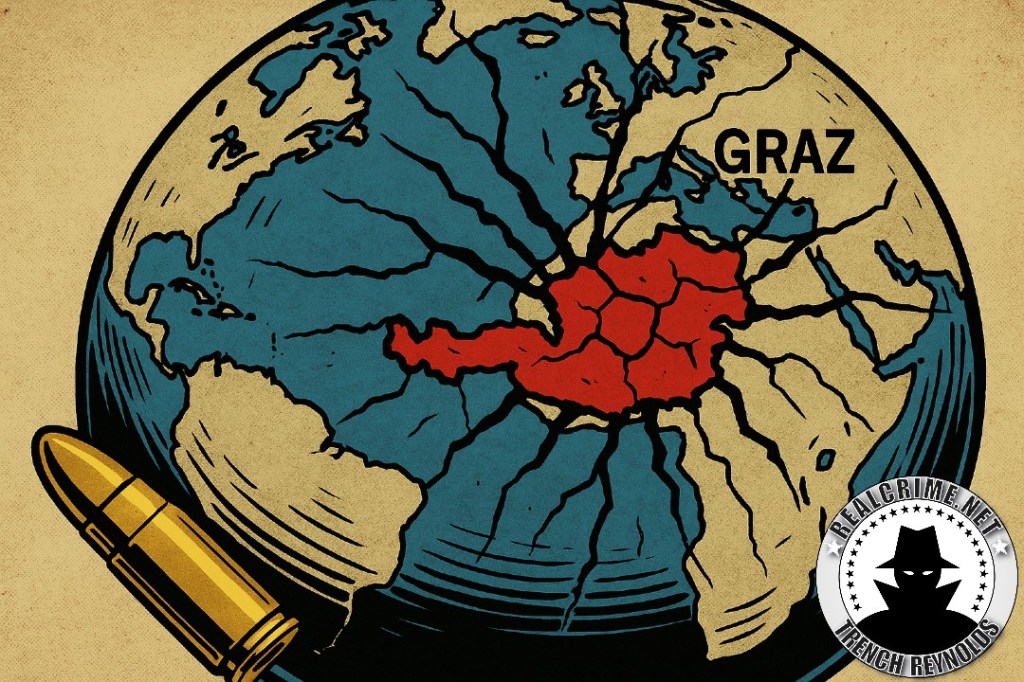
Another school has joined the growing global roster of tragedy. On the morning of June 10, 2025, a 22-year-old former student opened fire inside BORG Dreierschützengasse, a secondary school in the city of Graz, Austria. The attack unfolded around 10 a.m. local time, ultimately claiming the lives of at least nine victims, including seven students and one teacher. The gunman then died by his own cowardly hand inside the school.
Reports indicate the shooter carried both a pistol and a shotgun. Police responded swiftly, evacuating the building and securing the scene. More than two dozen people were injured, with several in critical condition. Crisis intervention teams were deployed to assist survivors, and political leaders across Austria and Europe responded with shock and grief.
Despite the rarity of such events in Austria, this is not the first. The country has seen isolated incidents of public mass violence before, including a jihadist shooting in Vienna in 2020. And while school shootings in Europe are comparatively rare, they are not unheard of. Germany has experienced its share, most notably the 2009 massacre in Winnenden, where a former student killed 15 before taking his own life. In nearby Serbia, an elementary school shooting last year claimed the lives of eight children and a security guard.
Austria maintains some of the strictest gun laws in Europe. Automatic weapons are outright banned, and even lower-capacity firearms like revolvers or semi-automatic pistols require official permits and registration. Civilian gun ownership stands at about 30 firearms per 100 people, relatively high for Europe, but still heavily regulated. Transporting a weapon publicly requires a European Union-issued weapons pass. In theory, these are hurdles designed to prevent exactly this type of violence.
So it begs the question, why is this a rare event in Austria, yet a routine occurrence in the United States?
Gun access is one obvious piece of the puzzle, but not the whole picture. Cultural factors, mental health resources, the mythologizing of previous shooters, all of these play a role. America’s fixation on infamy and its consistent failure to address the root causes of mass shootings form a deadly cocktail. In contrast, European responses tend to emphasize containment and prevention, not thoughts and prayers.
As for the shooter’s motive, little has been confirmed. But if I had to hazard a guess, and beat the same dead horse I’ve been flogging for decades, I’d bet this was another Columbine copycat. It fits the pattern. The age. The target. The weapons. Taking the coward’s way out. We’ve seen it time and again, young men seduced by the infamy of those who came before them.
Austria is now grappling with a tragedy that, for many in the United States, has become disturbingly familiar. The shock, the mourning, the unanswered questions, all of it echoes events that play out far too often on American soil. The difference is that for Austria, this will likely be a wake-up call. For us, it’s just another Tuesday.
(Sources)
- Ten Killed in Austria School Shooting
- At least 10 people killed in school shooting in Austria’s second biggest city
- Shooter kills at least nine in attack on Austrian school, mayor says
- At least nine killed in Austria school shooting, authorities say
- Nine people killed in school shooting in Austria’s Graz
- School shooting in Austria leaves at least nine people dead in city of Graz, officials say
- At least eight killed in Austrian school shooting




 Real Crime with Trench Reynolds
Leave a comment