

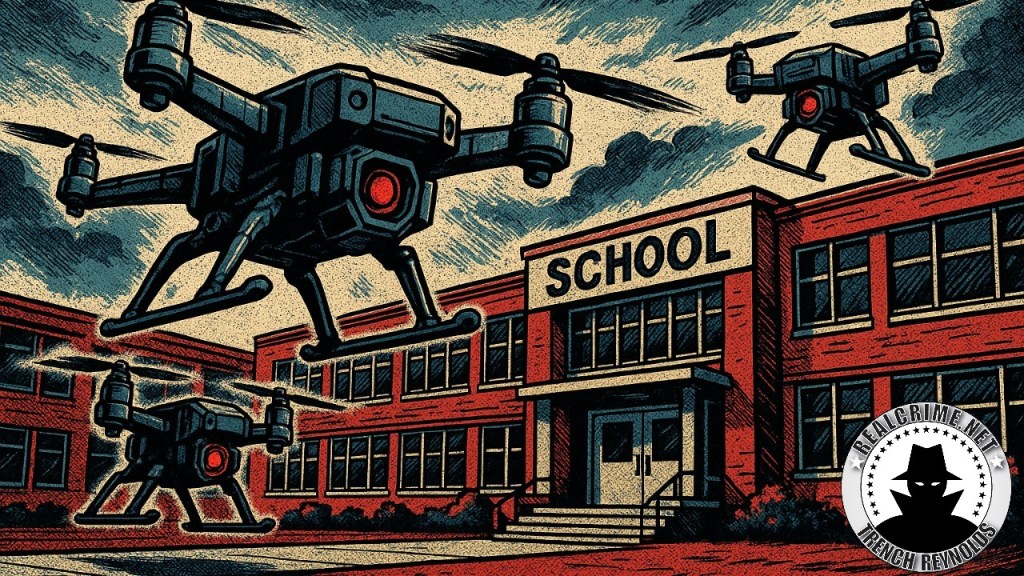
A Houston parent committee is now trying to raise half a million dollars to bring drone-based “school shooter response systems” to two Spring Branch ISD campuses. It sounds cutting-edge. It sounds bold. It sounds like action. But once you strip away the flashy demonstrations and the adrenaline-pumping sales pitch, you’re left with yet another example of how deeply we’ve lost the plot on school safety.
According to the parent leading the push, she was “blown away” by Campus Guardian Angel’s technology. That technology, if you believe the brochure, promises to respond to an active shooter in fifteen seconds with drones capable of punching through glass, blasting sirens and strobe lights, and firing pepper-ball rounds. The company’s co-founder, a retired Navy SEAL, even says his pilots can “hit you at 60 or 70 miles an hour.”
Of course they can, in a controlled demonstration, against a stationary dummy that doesn’t shoot back, on a day when everyone knows exactly what’s supposed to happen. There’s always a plan until reality enters the room. The last twenty or so years of school shootings have proven that every polished theory collapses the moment real gunfire starts.
And in this case, the public has already seen what happens when hyped-up school security tech meets real-world chaos. Baltimore County learned the hard way when Omnilert’s AI system, another “revolutionary” school-safety product, mistook a Doritos bag for a handgun and triggered an armed police response against a Black teenager who was simply walking down the hallway. That’s not a what-if. That already happened. A false positive in the wrong hallway at the wrong second doesn’t just waste time; it creates danger.
So imagine giving a private company real-time access to school cameras, entrance points, and control over weaponized drones, all based on threat-detection software that can misfire as easily as Omnilert’s did. What happens the first time one of these drones “sees” a gun where there isn’t one? Who gets pepper-balled? What student gets hit at 60 miles per hour because of a glitch? Who takes responsibility when a false alarm ends with a kid in the hospital?
None of these questions seem to be slowing down the enthusiasm in the Spring Branch ISD. A mother forms a 12-person committee, a police chief endorses the plan, and the district becomes yet another test site for yet another piece of high-tech security theater. Meanwhile, Texas continues to lead the country in school shootings, dating all the way back to the University of Texas Tower massacre. Decades later, the pattern remains the same: the state will try anything except the one thing that actually works, limiting access to firearms.
But this is Texas. Nothing meaningful will ever be done about gun control. Not after Santa Fe. Not after Uvalde. Not after the dozens of shootings in between. Instead, parents are told to settle for gadgets, panic buttons, AI watchers, and now drones. The political machine refuses to address the root cause, so the market rushes in to sell expensive distractions to families desperate for any illusion of safety.
And here’s the real question. If these parents believe so deeply in Campus Guardian Angel’s drone-based salvation, are they willing to pay for it with their own tax dollars? Because the committee pushing this program is hoping to catch Governor Greg Abbott’s attention. They want state funding. They want public money. They want every Texan, whether they support this tech or not, to help bankroll a drone fleet for schools.
Before taxpayers foot the bill for another unproven, error-prone, headline-friendly gadget, maybe we should be asking why we keep paying for everything except policies that would actually prevent kids from getting their hands on guns. Because no drone, no siren, no strobe light, no pepper ball, and no marketing pitch will ever outrun the reality that school shootings happen long before any machine powers up.
And the harsh truth is this. When these companies sell fear instead of solutions, when they deploy untested tech around children, and when a single false positive can turn into a life-threatening incident, these security startups have the potential to be just as dangerous as any active shooter.
(Source)



 Real Crime with Trench Reynolds
Leave a comment