

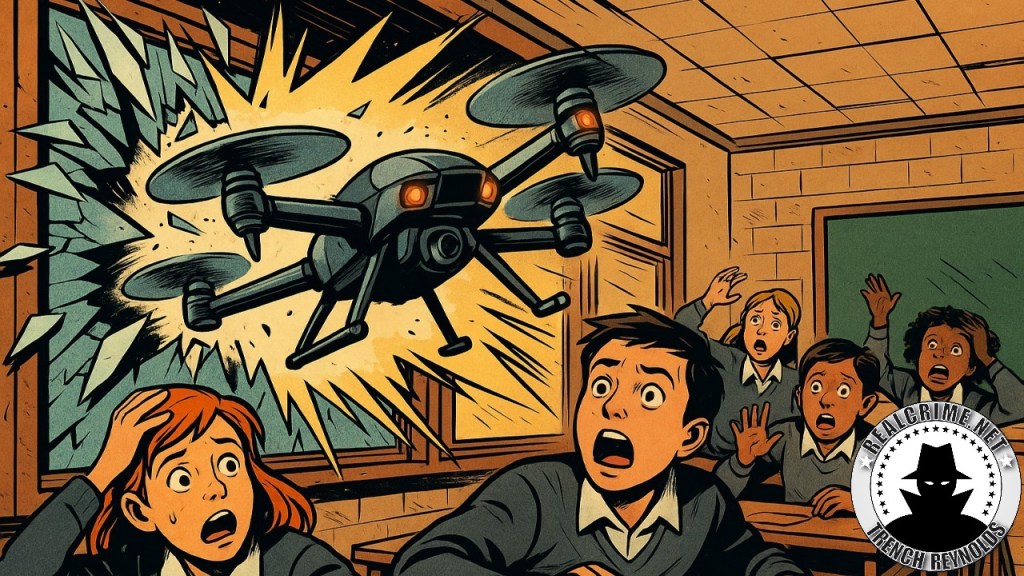
For months now, we’ve been talking about Campus Guardian Angel, the Texas startup promising that remotely piloted drones can stop school shooters with pepper spray, sirens, loudspeakers, and high-speed collisions. We covered the Florida pilot program funded with taxpayer dollars, the Houston parent committee begging for their own drone fleet, and the overall tech-bro fantasy that some gadget cooked up in a conference room can neutralize a problem created by unfettered gun access. And now another red state is stepping into the drone circus with big floppy clown shoes, Arkansas.
The company rolled into Conway to show off what it claims is the future of school safety. Officials were dazzled by the performance, which is exactly the point of these scripted demonstrations. What stood out even more than the theatrics, though, was their origin story. CEO Justin Marston proudly explained that he and his cofounder, a former Navy SEAL, came up with this idea while sitting in a Whataburger. Nothing against fast food, but hearing that a national school-safety ‘solution’ was conceived between ketchup packets and a Honey Butter Chicken Biscuit does not exactly inspire confidence.
The drones themselves are stored in boxes around school campuses. This raises a rather obvious question. What stops someone from blocking access to those boxes? Put a chair in front of it, jam something into the lid, throw a backpack over it, whatever it is, it won’t take a Navy SEAL to figure out. This is the kind of basic flaw you’d hope would be considered before asking taxpayers to bankroll a statewide rollout.
And the company says the drones can break through windows. They know because they tested it on a condemned high school. Crashing into an empty building scheduled for demolition is one thing; doing it during an actual shooting filled with noise, panic, movement, and unpredictability is something else entirely.
Marston has also insisted that if a pilot targets the wrong student, the lights, sirens, and audio warnings on the drone will somehow fix that. Right. Because during a real shooting, where kids are sprinting, ducking, screaming, and trying not to die, bright lights and a robotic voice yelling “DROP THE WEAPON!” will definitely turn everything into a calm, orderly identification scenario.
And while Arkansas officials gush over drones, sirens, and nonlethal “airborne interceptors,” the solution to school shootings has not changed in decades. Fewer guns. Less access to guns. Safer storage. Actual regulations. But this is Arkansas, where the political appetite for gun reform ranks somewhere just above “abolish football.” So instead of doing anything meaningful, the state rolls out the red carpet for a drone startup. Of course Campus Guardian Angel met with the governor’s team, they’re chasing government contracts and taxpayer money, not saving lives. And it speaks volumes that local police apparently had no idea any of this was happening. When money talks, communication apparently becomes optional.
For a school the size of Conway High School, the company recommends up to sixty drones positioned around campus. Sixty. That’s less “school safety system” and more “dystopian paperback cover art.” The company proudly touts its famous timing formula: respond in five seconds, reach the shooter in 15, incapacitate in 60. But here’s a question worth asking: how many rounds can be fired from an AR-15 in fifteen seconds?
Then there was Marston’s attempt at pop-culture philosophy, comparing his drone-pilot team to the agents from The Matrix. He described the ability of three operators to “jump anywhere” instantly and declared, “We’re the good guys.” I genuinely have no idea what he’s talking about. When your pitch for school safety veers into sci-fi analogies about digital super-agents, maybe your solution has drifted a bit too far from reality.
Arkansas may very well become the next testing ground for this elaborate illusion of action. But drones, sirens, and scripted demonstrations can’t fix what causes school shootings. They won’t stop a student from accessing an unsecured AR-15 at home. They won’t stop the political refusal to confront gun laws. They won’t stop the chaos that erupts the moment real gunfire begins.
What they will do is provide officials with something shiny to point at, another tech toy to parade during press conferences, another distraction that lets lawmakers keep avoiding the one thing that would actually make schools safer. In other words, a very expensive version of doing nothing.
(Sources)



 Real Crime with Trench Reynolds
Leave a comment