

Hey everybody. Sorry I’ve been quiet for a few weeks. I’ve been on what I’ve been calling an executive dysfunction sabbatical. If you know, you know.
I’m not even fully back yet. I’ve still got about 500 emails sitting in my inbox from late December onward that I haven’t touched. And that’s before factoring in how badly the murder of Renee Good rattled me. I tried to avoid the video. That only worked so well.
That said, my esteemed partner, Lady Gray, sent me an article that checked two boxes at once. It involved our state, the Free State of Kansas, and one of our state-level assclowns.
So, for the sake of my good lady, I dragged myself upright long enough to write this.
Apparently, Kansas has a new pitch for public schools. Install AI gun-detection software, or don’t get your share of the money.
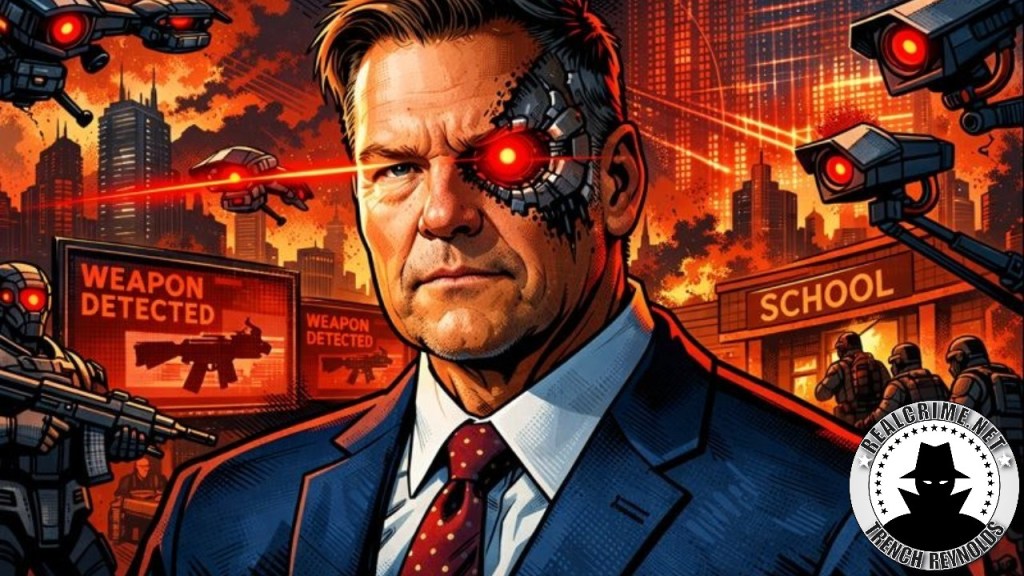
Kansas Attorney General Kris Kobach, said assclown, recently announced that schools willing to deploy AI gun-detection technology could receive a portion of a $10 million state fund. The message is simple enough. If districts want access to the cash, they’ll need to integrate the approved surveillance system into their hallways.
This is being framed as “support.” It sounds a lot more like extortion.
Because when the state says there’s money available, but only if you buy this product, we’re no longer talking about safety grants. We’re talking about coercion with better branding. Call it encouragement if it works for you. But in other industries, we’d just call it a shakedown.
The system being promoted is ZeroEyes, a Pennsylvania-based firm that specializes in AI-powered firearm detection through existing security cameras. The pitch is familiar. Lightning-fast alerts, military-veteran review teams, and promises that the software can identify a gun within seconds.
What’s less emphasized is the company’s real-world performance record.
Because this is the same class of technology that recently helped shut down Lawton Chiles Middle School when an automated system mistakenly interpreted a student holding a clarinet as if it were a rifle. A woodwind instrument. A Code Red lockdown. Police response. Parent panic.
The clarinet did not open fire, by the way.
This is not an isolated quirk. It’s a predictable failure mode. AI systems trained to spot “gun-like posture” don’t understand context, intent, or reality. They see shapes. They see angles. They escalate. And when they escalate, police respond as if a weapon is present because that’s what the system told them.
That’s how harmless behavior turns into life-altering encounters.
Yet instead of asking whether this technology meaningfully reduces harm, Kansas is offering financial incentives for schools to adopt it anyway. If districts want funding, they’ll need to agree to 24/7 automated surveillance of their students and staff, feeding footage into a private company’s operations center for constant review.
Again, totally ‘voluntary.’ Just very expensive to say no.
What makes this even harder to swallow is the ideological backdrop. Kobach has been explicit about his views on firearms. He opposes gun control. He supports expanding concealed carry rights, which includes lowering the eligibility age from 21 to 18. He has argued that teachers, coaches, and school staff should be allowed to carry guns on campus.
So the same official who wants more guns, carried by younger people, inside schools is also pushing AI surveillance to detect guns in schools.
If that sounds incoherent, it’s because it is.
On one hand, expanding access and normalization of firearms. On the other, pouring millions into technology designed to spot firearms once they inevitably appear. The contradiction isn’t accidental. It’s structural. AI gun detection doesn’t prevent shootings. It reacts to them, often incorrectly, while leaving the underlying access problem untouched.
This isn’t a solution. It’s security theater with a purchase order.
And let’s be honest about what this funding model incentivizes. Schools under financial pressure are being nudged toward surveillance tools not because they’ve proven effective, but because rejecting them now comes with a cost. Decline the system, lose the money. Accept the system and hope the AI doesn’t mistake a band kid for a threat.
If Kansas were serious about preventing school shootings, the conversation would start with firearm access, not camera analytics. But that conversation remains off-limits. Instead, we get another expensive layer of technology designed to detect a crisis after it’s already walked through the door, or, just as often, after it hasn’t.
(Source)



 Real Crime with Trench Reynolds
Leave a comment